




Supply in the global memory market is very tight right now, and artificial intelligence is not making things any easier. In the second quarter of 2026, global DRAM industry revenue reached approximately $154.73 billion. This is a 59.5% increase from the previous quarter, according to TrendForce.
This growth was mainly caused by the increased contract price of conventional DRAM and, of course, the increasing demand from AI server manufacturers.
By all indications, there’s little chance that this demand will slow down anytime soon. Considering the fact that manufacturers are also prioritizing High-Bandwidth Memory (HBM) production, conventional DRAM supply is facing more pressure.
For Indian businesses, these global supply constraints could also influence server procurement costs, hardware availability, and cloud infrastructure investments.
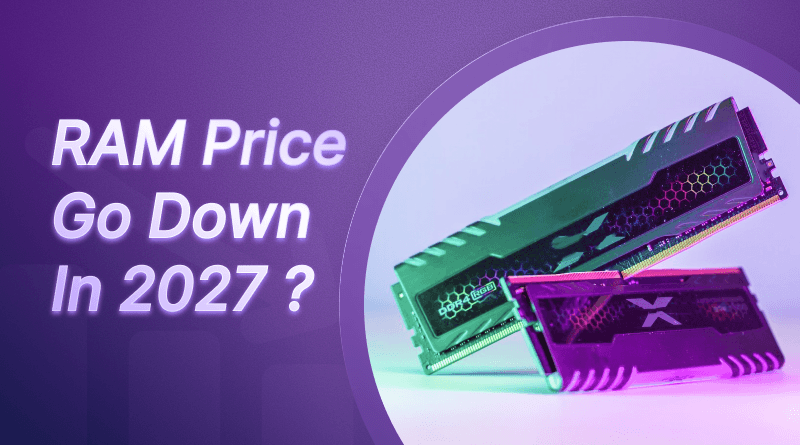
The question now is this: will new manufacturing capacity bring RAM prices down in 2027, or will AI-driven demand keep prices elevated? Let’s find out.
Why Are RAM Prices Increasing Globally?
Before we put some of the blame on AI, we have to admit that there’s a huge issue with supply-and-demand. Businesses across India are purchasing servers and computing infrastructure to support AI, cloud services, and enterprise applications. These systems need loads of memory to handle workloads efficiently.
Then, there’s also the demand for conventional DRAM coming from PCs, smartphones, and other electronic devices.
The problem here is that manufacturers cannot increase production immediately to meet all these sudden increases in demand. Running semiconductor manufacturing is not a walk in the park. It requires specialized equipment, facilities, technical expertise, and considerable capital investment.
Because demand is more than the available supply, manufacturers are somewhat in charge of pricing so they can push memory prices upward as they dim fit.
More so, manufacturers are now adjusting their priorities when it comes to production. Recently, there’s been a shift towards higher-value memory products, particularly HBM. So, manufacturers have to decide how to allocate limited production resources between different memory products.
As AI-related memory demand increases, production priorities change, potentially limiting the availability of conventional DRAM. I’m not exactly saying that all conventional RAM production has stopped. Manufacturers are still producing standard DRAM, but how they allocate capacity across product categories will affect overall supply.
How AI Data Centers and High-Performance Computing Are Driving Memory Demand
TrendForce’s latest research tells us that AI has taken up a huge chunk of the blame in the global memory shortage. This is because it takes enormous datasets to process and train large AI models. GPUs and other AI accelerators also need fast access to large volumes of data as well. India’s growing data centre hubs, including Mumbai, Hyderabad, Chennai, Bengaluru and Delhi NCR, are also contributing to the demand for server infrastructure
Memory has to do the heavy lifting for all these tasks by helping processors store and access the information needed during computation.
AI inference is another thing I just have to mention. The demand for computing infrastructure goes beyond the initial model-training stage as more businesses deploy AI applications.
Deloitte’s 2026 research forecasts that AI inference will account for approximately two-thirds of AI computing by 2026, with most of that computing still taking place in data centers and enterprise servers. That goes to say businesses will start considering using an already-trained AI model to generate responses, predictions, or other outputs.
This creates additional demand for memory and server infrastructure.
Apart from this, large cloud providers are expanding data centers to support AI workloads. These facilities need specialized servers equipped with high-performance processors and memory.
Traditional enterprise servers also need memory upgrades as workloads grow, yet again, increasing the number of people, businesses, and systems that depend on memory to function.
Why Are Manufacturers Prioritizing HBM Over Conventional DRAM?
HBM is a specialized type of DRAM designed to provide very high memory bandwidth. It is designed for specialized workloads that require significantly higher memory bandwidth and uses multiple DRAM dies stacked vertically. These stacks are connected using advanced packaging technologies.
Its architecture allows large volumes of data to move quickly between memory and processors. For Indian businesses purchasing server hardware, this shift in manufacturing priorities is worth monitoring as it could influence the availability and procurement costs of conventional DRAM.
Why does HBM production affect conventional DRAM supply?
HBM production needs multiple DRAM dies for each memory stack. It consumes substantial wafer capacity compared with conventional DRAM on a per-bit basis. When there’s a need to run advanced packaging and testing, it also introduces additional manufacturing requirements.
Additionally, there are very few available resources left for conventional memory products when manufacturers prioritize HBM production to serve AI hardware customers
This contributes to tighter supply across the wider DRAM market.
Will New Semiconductor Manufacturing Capacity Bring RAM Prices Down in 2027?
Major memory manufacturers are investing in expanding semiconductor manufacturing capacity. Some are constructing new fabrication facilities, while others are upgrading existing production lines. India is also investing in semiconductor manufacturing through initiatives such as the India Semiconductor Mission. However, these developments may take time to influence domestic memory supply.
Process improvements can also increase the number of memory bits produced from each wafer. This is good news, but it does not automatically mean additional memory will immediately become available.
For example, TrendForce expects meaningful contributions from several new facilities to emerge gradually, particularly in the second half of 2027, with more substantial output effects potentially arriving in 2028.
Even though manufacturing expansion is happening, not all new capacity will become productive at the same time. Building a semiconductor fabrication facility takes years. It also takes time to install specialized manufacturing equipment and prepare production lines.
So even if a facility starts initial production, it’s not realistic to expect them to reach their full capacity immediately. Manufacturers have to first improve yields and qualify products before they can scale production.
What Could Cause RAM Prices to Decrease or Remain High in 2027?
There are so many factors that will determine the actual RAM price forecast 2027. Let me explain the two possible market directions.
Factors that could bring prices down
– New manufacturing facilities
– Improved manufacturing yields and more efficient production processes.
– Reduced pressure on conventional DRAM if HBM production becomes more efficient.
– Slower AI infrastructure investment or reduced demand from major cloud providers.
– Weaker demand for PCs, smartphones, and other consumer electronics.
Factors that could keep prices elevated
– Continued expansion of AI data centers.
– Strong demand for HBM and server DRAM.
– Delays in new manufacturing capacity.
– Manufacturers prioritizing higher-value memory products.
– Long-term supply agreements that limit the amount of available memory in the open market.
– Rupee depreciation against the US dollar, potentially increasing imported hardware costs.
How Rising Memory Costs Could Affect Server Procurement and Cloud Hosting
The global memory shortage can also affect cloud hosting in some ways. Here’s why hosting providers should care:
1. Higher server procurement costs
Server systems rely on DRAM modules to support operating systems, databases, applications, and virtual machines. The amount of memory available to a website or application also depends on its hosting environment. For example, VPS hosting and shared hosting differ in how server resources such as RAM, CPU, and storage are allocated. If the price of memory is higher, it can increase the cost of purchasing or upgrading physical servers.
Any business deploying memory-intensive workloads might have no other choice than to deal with higher infrastructure budgets. Indian cloud service providers that purchase servers at scale may also need to adjust their procurement schedules and capital expenditure plans a bit.
2. Implications for cloud hosting providers
The cost of memory is part of the broader hardware investment required to operate hosting infrastructure. If there’s a persistent price increase, it could influence infrastructure expansion and server replacement decisions.
Hosting providers may also need to review hardware configurations, procurement agreements, and resource allocation.
This doesn’t necessarily mean that every hosting provider will immediately increase subscription prices. It depends on existing hardware inventories, supplier agreements, operating margins, and pricing strategies.
What Should Businesses Expect From the Global Memory Market in 2027?
If you run a business in India, don’t assume that memory prices will immediately return to previous levels. I would advise you to prepare for potentially elevated hardware procurement costs beforehand.
Businesses should equally review their infrastructure spending regularly. Practicing cloud cost optimization can help identify underused resources, right-size server capacity, and prevent unnecessary infrastructure expenses.
Also try as much as possible to evaluate memory requirements before purchasing infrastructure. Apart from that, keep an eye on how much you spend on hardware procurement and avoid unnecessary server capacity where workloads do not require it.
Ultimately, the 2027 memory market will depend on how quickly supply expands relative to AI-driven demand.
