



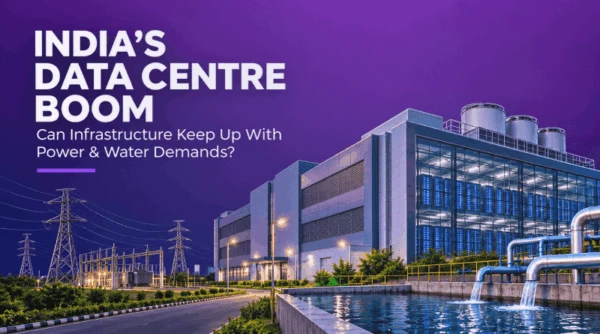
India’s data center industry is attracting billions of dollars in investment as technology companies expand their cloud computing and artificial intelligence infrastructure.
However, this rapid expansion is raising concerns about whether the country’s electricity supply, water resources, and supporting infrastructure can keep up.
A November 9 report by The Financial Express highlighted growing opposition to proposed data center projects in Thane and Visakhapatnam, with residents raising concerns about water availability, electricity demand, and environmental impact.
These developments show that building more facilities is only part of the challenge. Operators also need reliable power and cooling systems to keep them running.
So, what is driving India’s data center boom, and can its infrastructure support this growth? Let’s find out.
Why Is India Experiencing a Data Centre Boom?
India’s growing digital economy is one of the major reasons behind the expansion of its data center infrastructure. More businesses, consumers, and government institutions now depend on digital services to carry out everyday activities.
Online banking, e-commerce, digital payments, streaming platforms, and cloud-based applications all generate information that needs to be stored, processed, and accessed.
This creates demand for additional data center capacity.
Another factor I have to mention is the growing interest in local digital infrastructure. Businesses may prefer hosting their applications and storing information within India to improve latency, meet particular regulatory requirements, and maintain greater control over their data.
Government initiatives and private-sector investments are also encouraging this expansion. Sources reveal that India had approximately 147 data centers across its leading markets, with an operational capacity of around 1.8 GW in the first half of 2026.
Projections for 2030 are quite different. CareEdge Ratings estimates 4 GW, while the Council on Energy, Environment and Water (CEEW) projects approximately 6.5 GW. Some industry estimates are even higher, reaching 8–12 GW. These differences show how much expansion the industry could experience.
How AI and Cloud Computing Are Increasing Data Center Requirements
Traditional data centers already support everyday digital activities like hosting websites, storing databases, processing payments, and running business applications. As more people are starting to use artificial intelligence to host AI agents and do other tasks, it is changing the type and intensity of computing required.
Before an AI can be trained, one has to process large datasets to develop machine learning models. AI inference, on the other hand, happens when an already-trained model generates responses, predictions, or recommendations based on new information.
Both activities need computing resources, particularly powerful processors such as graphics processing units (GPUs). These processors can consume considerable amounts of electricity when handling demanding AI workloads.
Apart from AI, cloud computing is also contributing to the growing demand as well. Businesses increasingly rely on cloud platforms to store information, run applications, and access computing resources. While doing all this, they don’t maintain all the necessary physical infrastructure themselves.
As more organizations adopt these services, providers must expand their facilities to accommodate additional workloads. This means investing in more servers, electricity distribution systems, cooling technologies, and network infrastructure.
Why Electricity Availability Is Becoming a Major Data Centre Challenge
According to World Energy Council India estimates cited by The Financial Express, data centers consumed approximately 9–10 terawatt-hours (TWh) of electricity in FY25. This figure could increase to 35–50 TWh by 2030. The Indian government has also separately estimated that data center power demand could reach approximately 17 GW by 2031–32.
These figures measure different things. TWh represents the amount of electricity consumed over a period, while GW measures power capacity or demand.
Data centers operate 24/7. Because of this, their servers, cooling systems, networking equipment, and supporting infrastructure need a reliable electricity supply to maintain service availability.
However, having enough electricity generated across a country does not automatically mean that every proposed data centre can access the power it needs.
Operators also need suitable grid connections, sufficient local distribution capacity, and protection against power interruptions.
There are also other practical infrastructure challenges to consider:
- Grid capacity: Existing electricity networks may need upgrades to accommodate the additional demand from large facilities.
- Power reliability: Operators need dependable electricity connections and backup systems to prevent outages.
- Energy costs: Higher electricity consumption can increase the cost of running servers and cooling equipment.
- Renewable energy access: Providers need reliable ways to source cleaner electricity without compromising operational availability. For example, solar and wind energy can be used as an alternative.
Of course, building a stable electricity infrastructure will need proper planning and investment.
Why Water Consumption Is Becoming Another Infrastructure Concern
Electricity isn’t the only resource putting pressure on India’s expanding data centre industry. Water availability is becoming another important consideration, particularly for facilities that depend on water-based cooling systems.
Servers generate heat while processing information. So, data centers must remove this heat continuously to prevent equipment from overheating, malfunctioning, or experiencing reduced performance.
Some cooling technologies use water to absorb and transfer heat away from servers, which can increase demand for local water supplies.
India’s data centers consumed approximately 150.3 billion liters of water in 2025. This figure could reach nearly 359 billion liters by 2030.
This is already attracting attention in communities where households, agriculture, and other industries depend on limited water resources.
Another important thing to note is that not all data centers consume the same amount of water. Their requirements depend on cooling technology, facility design, climate, and computing workloads.
Operators therefore need to consider local water availability when selecting sites. They can also explore treated wastewater, water recycling, and alternative cooling systems to reduce their dependence on freshwater supplies.
How Data Centers Manage Cooling and Power Consumption
There are different technologies data center operators can use to manage heat and reduce resource consumption. These range from conventional cooling systems to newer liquid-cooling solutions designed for high-density computing environments.
Let’s take a look at some of them.
A. Conventional cooling systems
Air cooling uses fans, ventilation systems, and air-conditioning equipment to move heat away from servers. Chilled-water cooling uses water to absorb heat and transfer it to another part of the cooling system. Evaporative cooling, on the other hand, uses water evaporation to remove heat from the surrounding air.
Although these technologies help maintain suitable operating temperatures, some water-based systems can require substantial amounts of water.
B. Advanced cooling technologies
Direct-to-chip liquid cooling circulates coolant through cold plates attached to processors. This removes heat directly from high-temperature components and is particularly useful for demanding AI workloads.
Immersion cooling takes a different approach. It involves placing servers or selected electronic components in a specialized non-conductive liquid that absorbs heat.
Closed-loop cooling systems circulate coolant through sealed systems, reducing the need for continuous freshwater replacement. But yheir overall water requirements still depend on how heat is rejected from the facility.
A particularly interesting example where TierX Data Center Solutions estimates that liquid cooling with dry heat rejection could reduce water consumption by nearly 93% compared with conventional water-cooled chillers in a particular 1-GW facility scenario.
This is a scenario-specific estimate, not a guaranteed saving for every facility.
C. Power and resource efficiency
Operators can also improve efficiency through renewable electricity procurement, battery storage, uninterruptible power supply (UPS) systems, and better server utilization.
Another useful measure is Power Usage Effectiveness (PUE). It compares a data centre’s total energy consumption with the energy used by its IT equipment. A lower PUE generally indicates that less additional energy is being spent on cooling, power distribution, and other supporting operations.
Water Usage Effectiveness (WUE) equally provides a similar way to assess water consumption relative to IT energy use.
The Indian government has also highlighted advanced cooling technologies, renewable energy, and efficiency standards as part of its approach to sustainable data center development.
How Infrastructure Constraints Could Affect India’s Future Cloud Capacity
Announcing billions of dollars in data centre investments does not automatically mean that the proposed facilities will become operational on schedule. Developers still need suitable land, reliable electricity, adequate water supplies and supporting infrastructure.
Here are three ways these constraints could affect future expansion.
1. Delayed infrastructure expansion: Grid upgrades, environmental approvals, water access, and equipment procurement can delay construction or prevent facilities from reaching their intended capacity on time.
2. Higher operating costs: Operators may need to invest more in electricity distribution, renewable energy procurement, advanced cooling, and water treatment. These additional expenses can influence the cost of providing cloud and hosting services.
3. Uneven availability of cloud capacity: Regions with stronger electricity infrastructure, better network connectivity, and more reliable water supplies may become more attractive to developers.
CEEW’s research on India’s data center ecosystem also highlights the importance of coordinating infrastructure development, energy sourcing, and resource planning to support long-term resilience.
This doesn’t necessarily mean India will run out of cloud capacity. Instead, infrastructure constraints could slow expansion and make it more expensive if supporting utilities fail to keep up with demand.
If you are an Indian business that depends on cloud services and web hosting, I’m certain these developments raise another important question for you. So, what should you consider when choosing a hosting provider?
What Businesses Should Consider When Choosing a Hosting Provider
Indian businesses choosing a hosting provider usually focus on server performance, storage capacity, bandwidth, and pricing.
While these are good things to look at, the infrastructure supporting those services is equally important.
Here are a few things worth considering.
1. Data centre location
The location of a hosting provider’s data center can influence how quickly information travels between the server and website visitors. Consider where your customers are based and choose infrastructure that offers suitable latency, network connectivity, and any necessary data residency arrangements.
If you run a growing website and applications, scalable cloud hosting can give you access to flexible computing resources.
2. Infrastructure reliability
Find out whether the provider’s underlying infrastructure has redundant power supplies, UPS systems, backup generators, and cooling arrangements. Network redundancy, documented uptime commitments, and disaster recovery procedures are also important.
If you have applications that require greater control over computing resources, I believe scalable cloud VPS hosting is another option worth considering.
3. Hosting resources and scalability
Not every business needs the same infrastructure. A small website may work perfectly well with conventional cloud hosting, while a growing application may require additional CPU, RAM and storage.
Businesses running resource-intensive applications may benefit from VPS hosting or dedicated server infrastructure, depending on their requirements.
4. Sustainability and transparency
You should also consider whether your hosting provider shares information about its infrastructure efficiency, renewable electricity use, cooling technologies, and sustainability practices.
These details can help you understand how the provider manages its resources and prepares its infrastructure for future demand.
So Can India’s Data Center Infrastructure Keep Up?
There’s a lot of opportunities for AI, cloud computing, and the wider digital economy in India’s data centre boom.
Yet still, we will need more than investment in servers and physical facilities to sustain this growth. Reliable electricity, responsible water management, efficient cooling technologies, and better infrastructure planning will all play important roles.
